





Choosing an airline consolidator is not simply about finding the lowest airfare.
For a travel advisor, the right consolidator should provide useful airline and fare access, clear ticket rules, reliable post-ticketing support and booking tools that fit the way the agency works.
That becomes especially important with international travel, complicated itineraries, groups and premium-cabin bookings, where schedule, fare conditions and servicing can matter just as much as price.
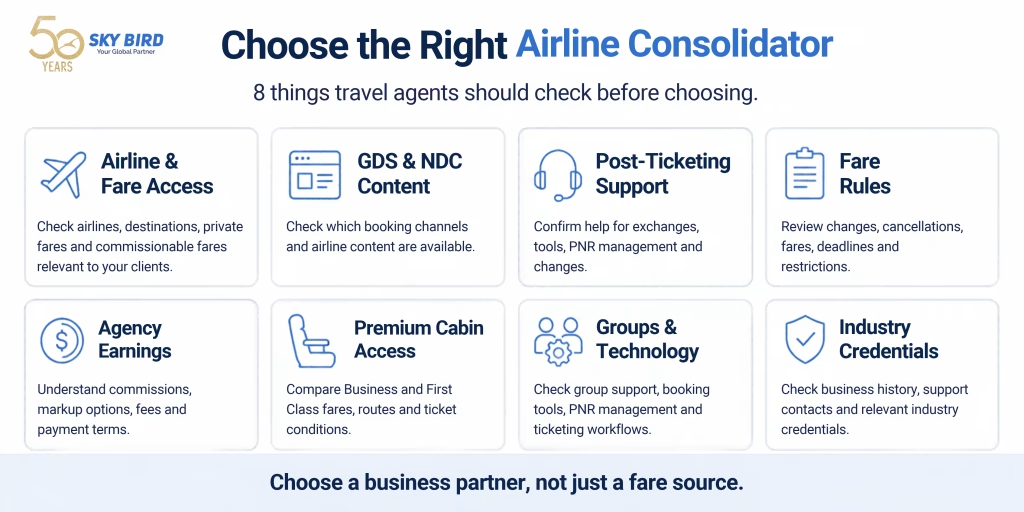
Quick answer: When comparing airline consolidators, look at airline relationships, private and commissionable fare access, GDS and NDC content, post-ticketing support, Business and First Class options, group capabilities, earning opportunities and industry credentials.
This guide explains how airline consolidators work, what travel agents should compare and what to look for when evaluating a business class consolidator.
What Is an Airline Consolidator?
An airline consolidator is a business that contracts with airlines and makes airfare available to travel agencies and other travel sellers.
IATA defines consolidators as businesses that contract with airlines to receive and sell airfares that are generally discounted below published fares. Consolidators may distribute those fares through retail travel agencies, travel management companies and, in some cases, directly to consumers.
For travel advisors, this can provide another source of airfare alongside airline-direct channels, Global Distribution Systems (GDS), New Distribution Capability (NDC) content and other distribution options.
Depending on the company, an airline consolidator may provide:
- Net or private airfares.
- Commissionable fares.
- International ticketing.
- Premium-cabin fare options.
- Multi-airline itinerary support.
- Exchanges and reissues.
- Schedule-change assistance.
- Group airfare.
- Booking and ticketing technology.
- Post-ticketing support.
Terms such as airfare consolidator, flight consolidator and airline wholesaler are also used in the industry, although individual companies can operate differently.
How Does an Airline Consolidator Work?
Airlines establish commercial agreements with consolidators. Eligible fares and other air content can then be made available to travel agencies under those agreements and the applicable fare conditions.
A travel advisor can compare those options with fares available through other channels and decide which itinerary offers the right balance of price, schedule, flexibility and service for the client.
Depending on the fare and the agency’s agreement, earning opportunities may come from:
- A commissionable ticket.
- A net fare that permits agency markup.
- Other supplier-specific compensation arrangements.
There is no universal discount percentage for consolidator fares.
The actual fare depends on factors such as the airline, route, cabin, inventory, travel dates and commercial agreement.
That distinction matters. “Generally discounted below published fares” does not mean every consolidator fare will be cheaper than every airline-direct fare. Advisors should compare the actual options available for the itinerary.
How Airline Consolidators Fit into Modern Air Distribution
Airline consolidation has changed along with airline distribution.
Traditional private and contracted fares remain relevant, but travel advisors now also work with content distributed through GDS platforms, NDC connections and other airline distribution technologies.
A modern consolidator can therefore play several roles:
- Airfare supplier.
- Booking-technology provider.
- Ticketing resource.
- Post-sale servicing partner.
When evaluating a consolidator, do not ask only:
“What fares do you have?”
Also ask:
- Where does the airfare content come from?
- Which airlines are available?
- Which GDS platforms are supported?
- Is NDC content available?
- Who issues the ticket?
- Who services the booking after ticketing?
Those questions become particularly important when the original itinerary changes.
What Should Travel Agents Look for in an Airline Consolidator?
The best airline consolidator for travel agents will depend on what the agency actually sells.
A leisure agency focused on international family travel may have different requirements from an agency serving corporate travelers, premium-cabin clients or groups.
Use the following criteria when comparing providers.
1. Airline Relationships and Fare Access
Start with the airlines and destinations your agency actually books.
A broad airline network can give advisors more options when comparing:
- International routes.
- Alternative connections.
- Premium cabins.
- Regional carriers.
- Multi-city itineraries.
- Net fares.
- Commissionable fares.
- Private airfares.
Do not judge a consolidator simply by the number of airline relationships it advertises.
The more useful question is whether those relationships support the destinations, cabins and client profiles your agency regularly sells.
Sky Bird, for example, publishes its airline contracts by destination region and fare type, allowing advisors to review relevant airline relationships when researching options.
2. GDS and NDC Content
Airfare is now distributed through several channels.
A consolidator may provide access to traditional GDS content, NDC offers or both.
When comparing providers, ask:
- Which GDS platforms are supported?
- Which airlines are available through NDC?
- Can different content sources be compared efficiently?
- How are NDC bookings serviced after ticketing?
- Can an agency import or manage existing PNRs?
A large content pool is useful only if the agency can efficiently book and service it.
For more information about this distribution model, review Sky Bird’s NDC resources for travel agents.
3. Post-Ticketing Support
Do not evaluate a consolidator only by what happens before payment.
Flights change.
A client may need assistance because of:
- A schedule change.
- A cancellation.
- An exchange.
- A reissue.
- A refund request.
- A missed connection.
- A change in travel plans.
Find out who handles those situations and when help is available.
For international and premium-cabin itineraries in particular, reliable servicing can be as important as the original fare.
4. Fare Rules and Transparency
A competitive consolidator fare is useful only when the advisor understands its conditions.
Before ticketing, review relevant rules such as:
- Change conditions.
- Cancellation rules.
- Refundability.
- No-show penalties.
- Ticketing deadlines.
- Minimum or maximum stay requirements where applicable.
- Routing restrictions.
- Baggage provisions.
Avoid making a recommendation based only on the displayed fare.
The client needs to understand what can and cannot be changed after purchase.
5. Agency Earnings and Markup Options
Travel agents should also understand how the consolidator’s commercial model works.
Depending on the fare and supplier agreement, an agency may have access to:
- Commissionable airfare.
- Net fares that allow markup.
- Other earning arrangements.
Ask:
- Which fares are commissionable?
- Which fares permit markup?
- Can the advisor control the markup?
- When are commissions paid?
- How do exchanges and refunds affect earnings?
- Are ticketing or service fees involved?
The goal should be transparent earnings rather than chasing the highest advertised commission.
Business and First Class Fare Access
Premium-cabin bookings deserve separate attention.
If your agency regularly serves corporate travelers, luxury clients or long-haul passengers, ask about the consolidator’s Business and First Class capabilities.
Compare:
- Airline choices.
- Private or contracted fare availability.
- Routing.
- Aircraft.
- Fare restrictions.
- Change conditions.
- Ticketing support.
A premium-cabin ticket can represent a high-value booking, making both fare conditions and post-ticketing support particularly important.
What Is a Business Class Consolidator?
A business class consolidator generally refers to an airline consolidator that provides access to, or specializes in, premium-cabin airfare such as Business Class and sometimes First Class.
It does not mean every Business Class fare will be cheaper than booking directly with the airline.
For travel advisors, the value is having additional premium-fare options to compare with other available booking channels.
A business class consolidator may be particularly useful when a client:
- Is traveling internationally.
- Has flexible airline preferences.
- Is open to alternative connections.
- Needs a long-haul Business Class itinerary.
- Wants several premium-cabin options compared.
- Requires support with a high-value ticket.
How to Compare Business Class Consolidator Fares
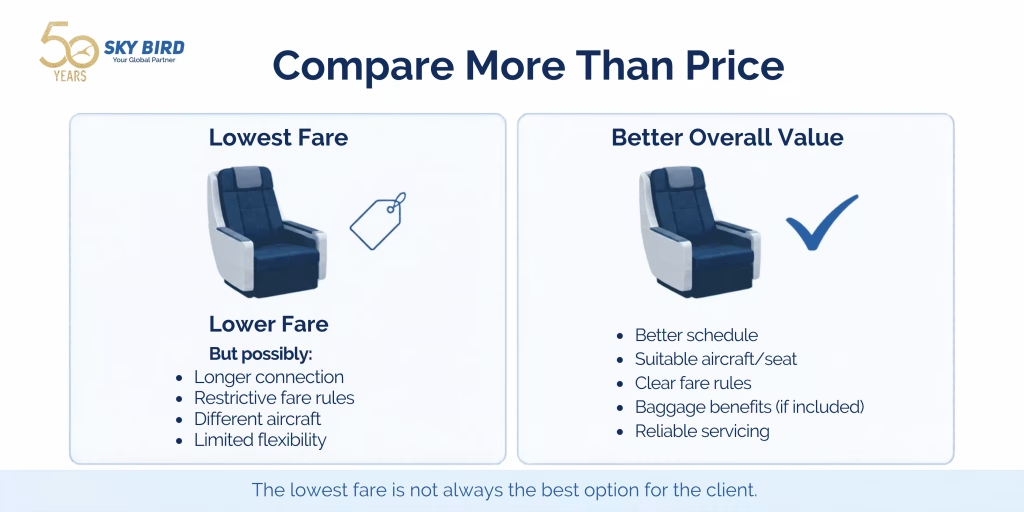
Do not compare business class consolidator fares by price alone.
Look at the complete itinerary.
- Operating airline: Which carrier actually operates each segment?
- Aircraft: Does the aircraft offer the Business Class product the client expects?
- Seat: Is it lie-flat? Does it provide direct aisle access?
- Travel time: Does the lower fare require a much longer connection?
- Fare rules: What happens if the client’s plans change?
- Baggage: What does the ticket include?
- Lounge access: Does this particular ticket qualify?
- Servicing: Who handles exchanges, reissues or schedule changes?
For premium travel, a slightly higher fare with a better schedule or more flexible conditions can sometimes offer better overall value than the lowest available fare.
Group Airfare Capabilities
If your agency sells groups, include group support in your evaluation.
Group bookings can involve:
- Deposits.
- Name deadlines.
- Payment schedules.
- Seat allocations.
- Airline-specific contract terms.
- Special ticketing deadlines.
Ask whether the consolidator has a dedicated group department and which types of groups it regularly handles.
This may be relevant for:
- Student groups.
- Religious travel.
- Corporate groups.
- Destination weddings.
- Sports travel.
- Meetings and incentives.
Group airfare follows different processes from standard individual bookings, so specialist support can be useful.
Booking Technology
Technology should save advisors time rather than create another workflow problem.
Useful capabilities can include:
- Multi-airline search.
- Fare comparison.
- GDS access.
- NDC content.
- PNR management.
- Instant ticketing.
- Markup controls.
- Commission visibility.
- Booking history.
Technology should still be backed by servicing.
When an itinerary becomes complicated, access to someone who understands ticketing can matter more than another automated feature.
Industry Credentials and Business History
Before trusting a supplier with client travel and payment information, confirm who you are doing business with.
Depending on the provider, relevant industry relationships or credentials may include organizations such as:
Also review:
- How long the company has operated.
- Where it is located.
- How support can be reached.
- Whether its leadership is identifiable.
- Whether its industry credentials can be independently verified.
Credentials alone do not guarantee service quality, but transparency helps an agency perform proper due diligence.
Why Do Travel Advisors Use Airline Consolidators?
Travel advisors may use an airline consolidator for several reasons, including access to additional airfare options, ticketing support, earning opportunities and assistance with more complicated bookings.
A consolidator is not automatically the right booking channel for every itinerary.
Sometimes an airline-direct fare or another source may be the better option.
The practical approach is to compare available channels based on:
- Route.
- Fare conditions.
- Schedule.
- Cabin.
- Client priorities.
- Servicing needs.
For a deeper look at this topic, read Why Should Travel Advisors Use an Airline Consolidator?
Common Misconceptions About Airline Consolidators
Some perceptions of airline consolidators are based on older distribution models.
Questions often arise around:
- Fare restrictions.
- Ticket flexibility.
- Support.
- Airline access.
- Who can use consolidators.
- How consolidator fares compare with published fares.
Rather than assuming all consolidators and all tickets work the same way, evaluate the actual provider and fare conditions.
IATA’s broader definition is useful here: consolidators contract with airlines to receive and sell airfares that are generally discounted below published fares. That does not support a fixed savings percentage for every booking.
For more detail, read Misconceptions of Airline Consolidators.
Questions to Ask Before Choosing an Airline Consolidator
Before opening an account or placing an important booking, ask:
- Which airline contracts are most relevant to the destinations my agency sells?
- Do you provide both GDS and NDC content?
- What Business and First Class options are available?
- What support is available after ticketing?
- How are exchanges, reissues and refunds handled?
- Can my agency control markup on eligible fares?
- How and when are commissions paid?
- Do you have dedicated group specialists?
- Which booking and ticketing tools are available?
- What industry credentials does the company maintain?
Clear answers make it easier to compare providers on more than price.
Quick Airline Consolidator Evaluation Checklist
What to Evaluate | What to Look For |
Airline access | Relevant airline contracts for your core destinations |
Fare options | Private, net, commissionable and other eligible fares |
Premium cabins | Business and First Class capabilities |
Distribution | GDS and NDC content that fits your workflow |
Fare transparency | Clear rules before ticketing |
Support | Help with exchanges, reissues and disruptions |
Groups | Dedicated expertise where needed |
Earnings | Clear commission and markup model |
Technology | Search, booking, ticketing and PNR tools |
Credibility | Verifiable history, contacts and industry credentials |
A good airline consolidator should fit the way your agency sells and services airfare instead of forcing the agency into an unfamiliar process.