




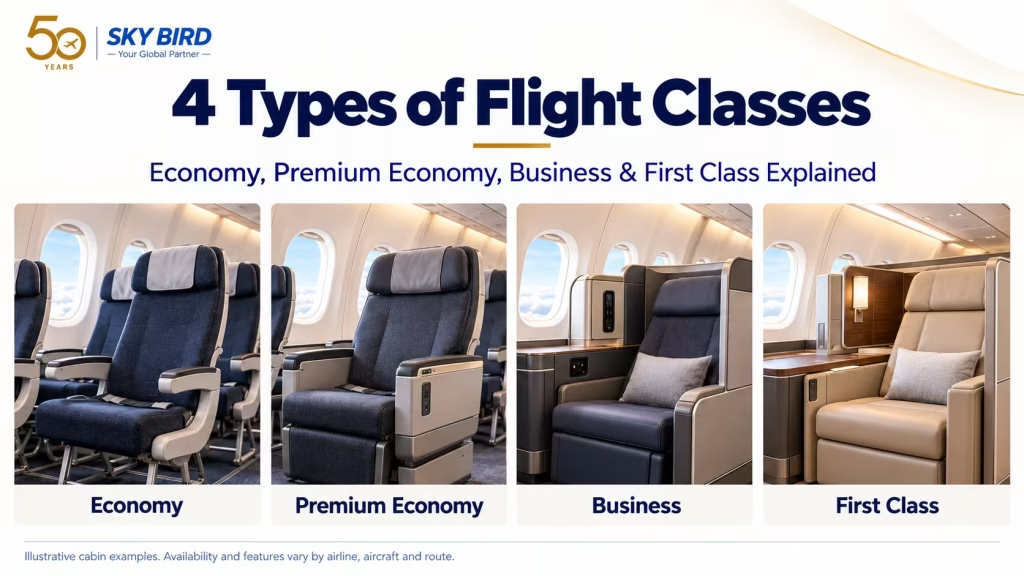
What Are the 4 Main Types of Flight Classes?
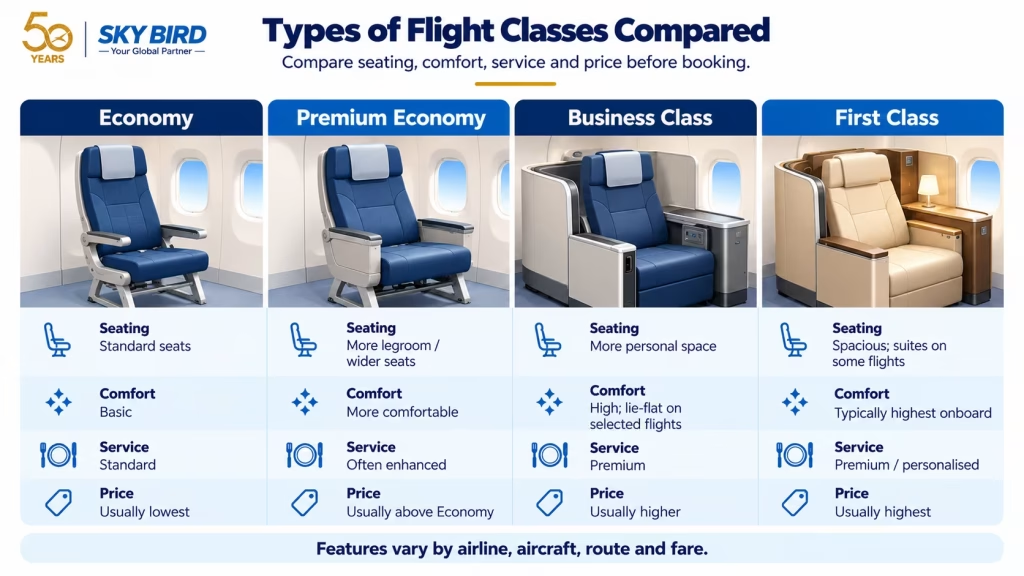
The four main types of flight classes are Economy, Premium Economy, Business, and First.
The differences become clearer when you look at each individually.
1. Economy Class
Economy Class is the standard cabin on most commercial passenger flights and is generally the lowest-priced way to travel.
For many travelers, it provides the right balance between price and basic comfort.
What Does Economy Class Usually Include?
Depending on the airline, route and fare, an Economy ticket may include:
- A standard passenger seat.
- Carry-on baggage according to the airline’s policy.
- Checked baggage on some fares.
- Meals or snacks on selected flights.
- Entertainment on equipped aircraft.
- Seat selection, either included or available for a fee.
The words “Economy Class” do not tell you everything about the ticket.
Two people sitting in the same Economy cabin can have different baggage allowances, seat-selection rights, change conditions, or refund rules because they bought different fares.
Basic Economy vs. Standard Economy
This distinction is particularly relevant for travelers in the United States.
Basic Economy generally refers to an airline’s lower-priced Economy fare with additional restrictions.
Those restrictions vary by carrier.
For example, Delta’s Basic fare information explains that its Basic product has restrictions relating to areas such as advance seat assignments, upgrades, ticket changes and boarding.
Other US airlines structure their Basic Economy products differently, so travelers should always check the actual fare rules.
A slightly more expensive Economy ticket may provide better value once seat selection, baggage and flexibility are taken into account.
Who Is Economy Class Best For?
Economy can work well for:
- Travelers focused primarily on prices.
- Short domestic trips.
- Passengers who do not need additional legroom.
- Travelers would rather use more of their budget at the destination.
2. Premium Economy Class
Premium Economy sits between Economy and Business Class.
It is designed for travelers who want noticeably more comfort than standard Economy without paying the much higher price that can come with Business Class.
What Does Premium Economy Usually Include?
Depending on the airline and aircraft, travelers may find:
- More legroom.
- A wider seat.
- Greater recline.
- A separate cabin.
- Enhanced meals or drinks.
- Priority airport services.
- Additional baggage.
- Upgraded amenities.
A genuine Premium Economy cabin should not be confused with an extra-legroom Economy seat.
For example, American Airlines Premium Economy is a separate product on selected aircraft, with wider seats, more legroom and priority privileges.
Delta’s Premium Select is another example of a distinct premium-economy product, with more space and additional amenities on eligible flights.
Economy vs. Premium Economy
The most noticeable difference between Economy vs. Premium Economy is normally the seat.
Premium Economy may provide:
- More legroom.
- Greater seat width.
- More recline.
- A smaller or separate cabin.
- Additional onboard or airport benefits.
Whether it is worth paying more depends heavily on the route.
An extra few inches of space may matter much more on a 12-hour overnight flight than on a two-hour domestic trip.
Who Is Premium Economy Best For?
Premium Economy can be a good fit for:
- Long-haul travelers who want more personal space.
- Taller passengers.
- Travelers who want better comfort without paying for Business Class.
- Passengers looking for a middle ground between price and premium service.
Sky Bird Advisor Note: Cabin labels should be the beginning of the comparison, not the end. Sky Bird works with more than 90 airline partners, and airline products are not standardized. When comparing options for a client, look at the actual aircraft, seat and fare benefits rather than assuming two Premium Economy products are equivalent.
3. Business Class
Business Class is a premium cabin built around more space, comfort and service.
The experience can differ dramatically between a short regional flight and a long international journey.
On many long-haul aircraft, Business Class includes seats that convert into fully flat beds. Shorter flights may use larger recliner seats, or, in some markets, a modified economy-style configuration.
What Does Business Class Usually Include?
Depending on the airline, aircraft, route and fare, Business Class may include:
- More spacious seating.
- Lie-flat seats on many long-haul flights.
- Premium meals and beverages.
- Priority check-in.
- Priority boarding.
- Lounge access for eligible travelers.
- Higher baggage allowances.
- More personalized service.
Again, the cabin name does not guarantee every benefit.
Lounge access, ticket flexibility, and baggage rules should be confirmed for the actual fare being sold.
Economy vs. Business Class
The difference between Economy vs. Business Class becomes especially noticeable on long-haul travel.
Business Class often provides:
- Considerably more personal space.
- Better sleeping arrangements.
- Premium airport services.
- Upgraded dining.
- Priority treatment at different stages of the journey.
- The trade-off is price. Business fares can be considerably more expensive.
Premium Economy vs. Business Class
When comparing Premium Economy vs. Business Class, the seat is usually the biggest distinction.
Premium Economy typically offers a better version of a conventional airline seat.
Business Class on many long-haul aircraft may offer:
- A fully flat bed.
- Direct aisle access.
- Lounge access.
- Premium dining.
- More privacy.
- Priority airport services.
For an overnight international journey, this can make a significant difference to how rested a traveler feels on arrival.
Who Is Business Class Best For?
Business Class may make sense for:
- Long-haul travelers.
- Travelers who need to work during the journey.
- Passengers taking overnight flights.
- Travelers who place a high value on sleep and personal space.
- Clients who value lounge access and premium airport services.
4. First Class
First Class is the highest passenger cabin offered by some airlines.
It is not available on every airline, route or aircraft.
Where First Class is offered, it generally provides the airline’s highest level of privacy, space and personalized service.
What Does First Class Usually Include?
Depending on the airline and aircraft, First Class may offer:
- Private or semi-private suites.
- Large seats that convert into beds.
- Premium dining.
- More personalized onboard service.
- Exclusive airport lounges.
- Dedicated check-in.
- Priority services.
- Generous baggage allowances.
There is no universal First Class product.
British Airways First, for example, includes a private suite and fully flat bed on its First Class product. Other airlines design First Class differently.
Business Class vs. First Class
The difference between Business Class vs. First Class is increasingly about privacy, exclusivity and service rather than simply whether the seat turns into a bed.
A strong modern Business Class product may already include:
- A fully flat seat.
- Direct aisle access.
- Lounge access.
- Premium dining.
- Considerable privacy.
First Class may add:
- A larger or more private suite.
- More personalized service.
- More exclusive airport facilities.
- Higher-end food, amenities or ground services.
That also means First Class is not automatically the best value.
For some travelers, a good Business Class product may provide most of the comfort they want at a lower fare.
Who Is First Class Best For?
First Class may appeal to travelers who:
- Place a high value on privacy.
- Want the airline’s most premium experience.
- Are traveling long distances.
- Value highly personalized service.
- Have the budget for the highest cabin.
What Is the Main Difference Between Flight Classes?
The main difference between different flight classes is how much space, comfort and service the ticket provides.
- Economy focuses most heavily on affordability.
- Premium Economy adds extra space and selected comforts.
- Business Class usually provides a much more premium experience, particularly on long-haul flights.
- First Class, where offered, is generally the airline’s highest level of service.
- Price matters too, but paying for a higher cabin does not mean every possible benefit is included.
- Baggage, lounge access, changes, refunds and seat selection can still depend on the fare purchased.
Are Airplane Seat Classes the Same as Flight Classes?
The phrases airplane seat classes, airplane classes, flight classes and cabin classes are often used when talking about the different passenger cabins on an aircraft.
Airlines, however, frequently use their own branded names.
British Airways is a useful example:
- World Traveler is long-haul Economy.
- World Traveler Plus is a Premium Economy.
- Club World is long-haul Business.
- First is its First Class product.
Other airlines use entirely different names.
This is why travelers should compare the actual product instead of assuming the cabin name tells the whole story.
Cabin Class vs. Fare Class: What Is the Difference?
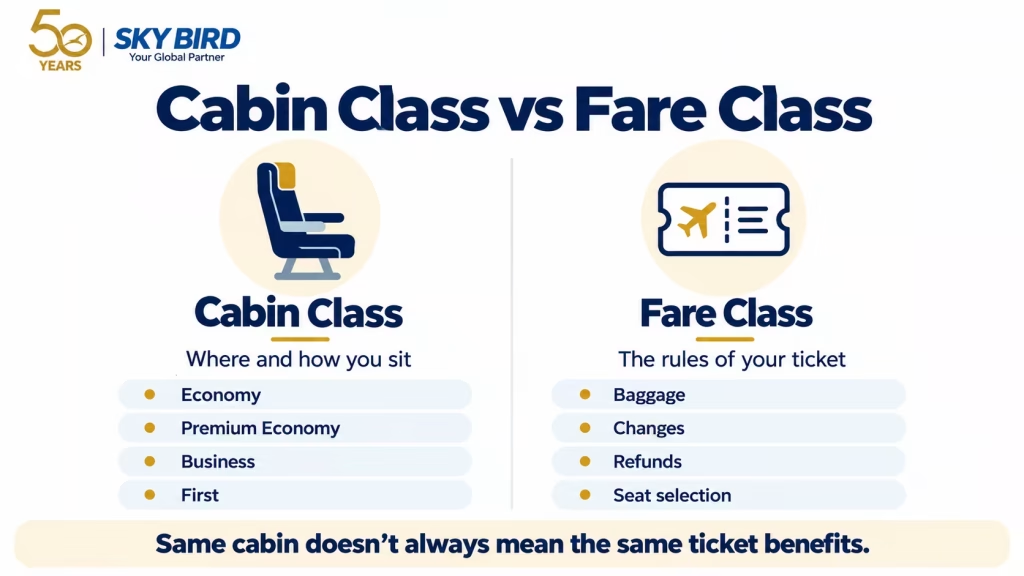
Cabin class and fare class are not the same thing.
Cabin Class
Cabin class describes the onboard product.
Examples include:
- Economy.
- Premium Economy.
- Business.
- First.
Fare Class
Fare class relates to how the ticket is sold and the conditions attached to it.
It can affect areas such as:
- Ticket flexibility.
- Refundability.
- Seat selection.
- Loyalty-program earning.
- Upgrade eligibility.
- Price.
Fare classes and booking codes are not standardized across all airlines.
The distinction has become even more important as airlines introduce multiple fare options inside the same cabin.
For example, Delta now sells different fare experiences within some premium cabins. Its Premium Select product can have different fare options while passengers still sit in the Premium Select cabin. The seat product can therefore remain similar while flexibility and other ticket conditions differ.
Simple way to remember it:
The cabin tells you where and how you will generally sit. The fare tells you what rules and benefits come with the ticket.
Sky Bird Advisor Note: When comparing fares for a client, do not stop at “Economy,” “Premium Economy” or “Business.” Review the operating carrier, fare conditions, and included services as well. Two tickets in the same cabin can have different rules and different overall value.
How to Choose the Right Flight Class
There is no single flight class that is best for everyone.
The right choice depends on the traveler, route, budget and reason for the trip.
1. Consider the Length of the Flight
For a short domestic flight, standard Economy may be perfectly adequate.
For a long-haul or overnight journey, more legroom or a lie-flat seat may be worth substantially more to the traveler.
2. Compare the Total Price
Do not look only at the first fare displayed.
Also consider:
- Baggage charges.
- Seat-selection fees.
- Change restrictions.
- Refundability.
- Meals.
- Airport benefits.
A slightly more expensive ticket can sometimes be better value once the extras are included.
3. Compare the Actual Seat
The same cabin can look very different from one aircraft to another.
Check:
- Seat width.
- Seat pitch.
- Recline.
- Lie-flat capability.
- Direct aisle access.
- Aircraft type.
This is particularly important when comparing Business Class.
4. Check What the Fare Actually Includes
Before booking, review:
- Baggage allowance.
- Seat selection.
- Lounge access.
- Meals.
- Priority services.
- Change rules.
- Cancellation and refund conditions.
Do not assume the cabin automatically includes a particular service.
5. Think About the Traveler’s Priorities
What matters most?
A traveler may care primarily about:
- Price.
- Legroom.
- Sleep.
- Privacy.
- Lounge access.
- Baggage.
- Ticket flexibility.
Once the priority is clear, comparing cabins becomes much easier.
6. Check the Aircraft and Operating Airline
Do not assume that every flight carrying the same airline code uses the same cabin product.
Aircraft changes, partner airlines and codeshare arrangements can affect the experience.
Whenever possible, check the aircraft and operating carrier before booking.
Travel advisors looking to evaluate their booking partners can explore our guide to choosing the right airline consolidator and learn what to consider when selecting one for their agency.